What happens when you put 21 educators in one incredible makerspace for 5 days, hand them a real client, and say "go"?
I got to find out firsthand. Last week, I participated in MakerEd Jam, a 5-day, in-person, collaborative week hosted at Dawson School's Innovation Center in Lafayette, CO. Sixteen participants (mostly makerspace leaders from schools around the country) and five facilitators came together to design and build for a real-world client: the WOW Children's Museum, just down the road.
The event was led by Jeff Ellenbogen, Chris Supiro, and Glenn Salaman (leaders of Dawson's Innovation Center), Zack Weaver (CU Boulder's ATLAS Institute and BTU Lab), and Shawn Hymel (education content creator and technologist).
And the whole week, start to finish, we documented in Unrulr. (Yes, I gave a quick Unrulr demo. Yes, I was probably perceived as the Unrulr plant. But I was there as a full participant; building, iterating, and documenting right alongside everyone else.)
If you work in experiential or work-based learning, you know the term "client-connected projects." MakerEd Jam was exactly that. Except this time, the educators were the students.
The WOW Children's Museum needed exhibit improvements and new builds, all designed for their core audience: mostly young kids roughly 3-8 years old, many of them Spanish speakers, all of them guaranteed to pound on, hang from, and spill things onto whatever we made. Everything had to be kid-safe, ultra-durable, approachable without written instructions, and easy for museum staff to install and maintain.
We formed four teams:
Our point of contact at the museum, Josie, was phenomenal! She answered endless questions, visited Dawson to give feedback, and helped every team through multiple iteration cycles. (Also: the WOW Museum is just a really fun place to be, even for adults. Highly recommend.)
For our project, we worked on updating the existing Make It Go! exhibit. The basic premise is a track for small wooden cars, outfitted with magnetic slots for experimenting with person-shaped weights. Kids test how different amounts of weight affect the speed of the car down the track (don't ask me about the physics or equations).
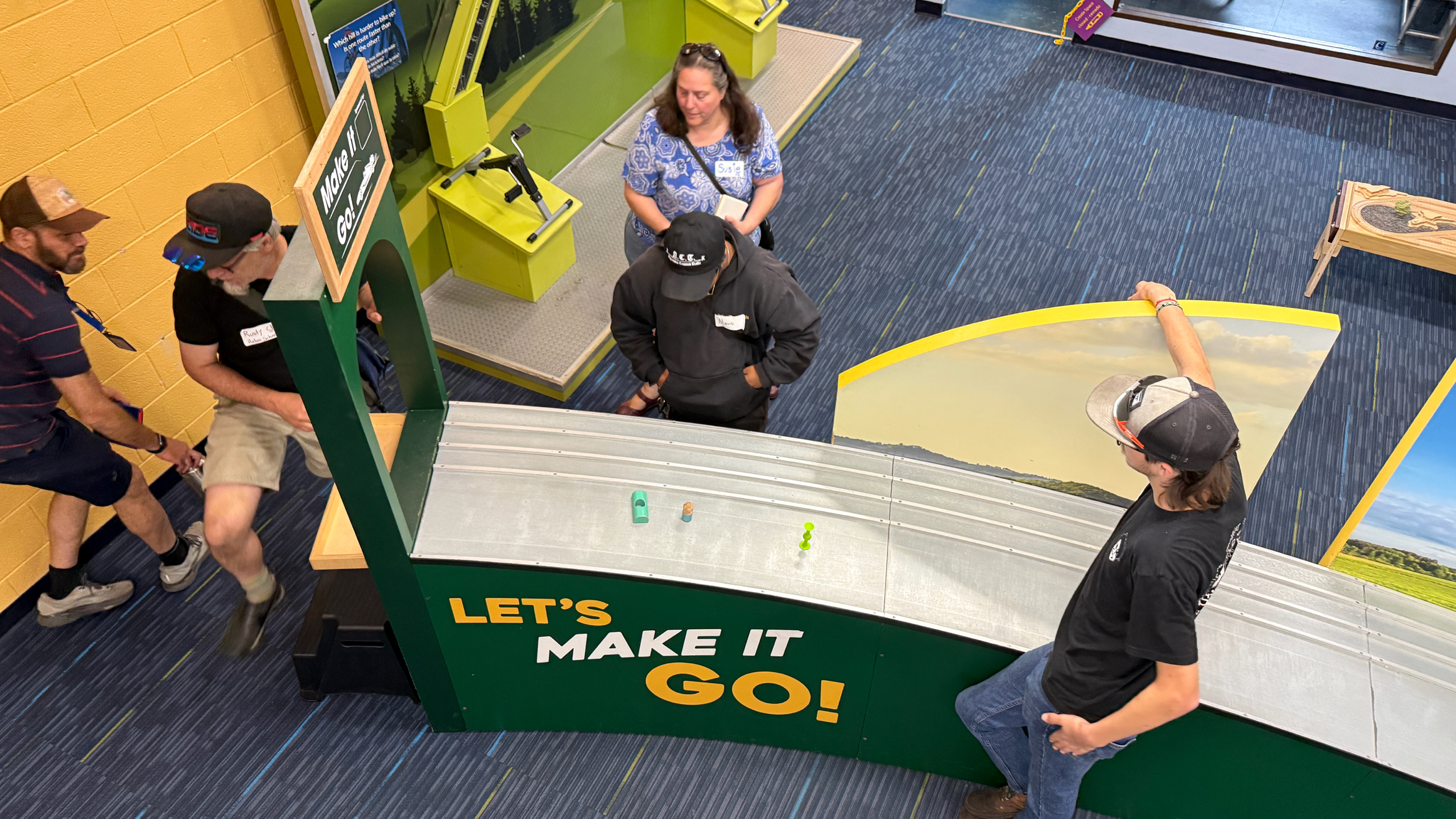
We determined that the exhibit would benefit from some electronics to help with accurate speed testing, plus a little pizzazz to make it more exciting.
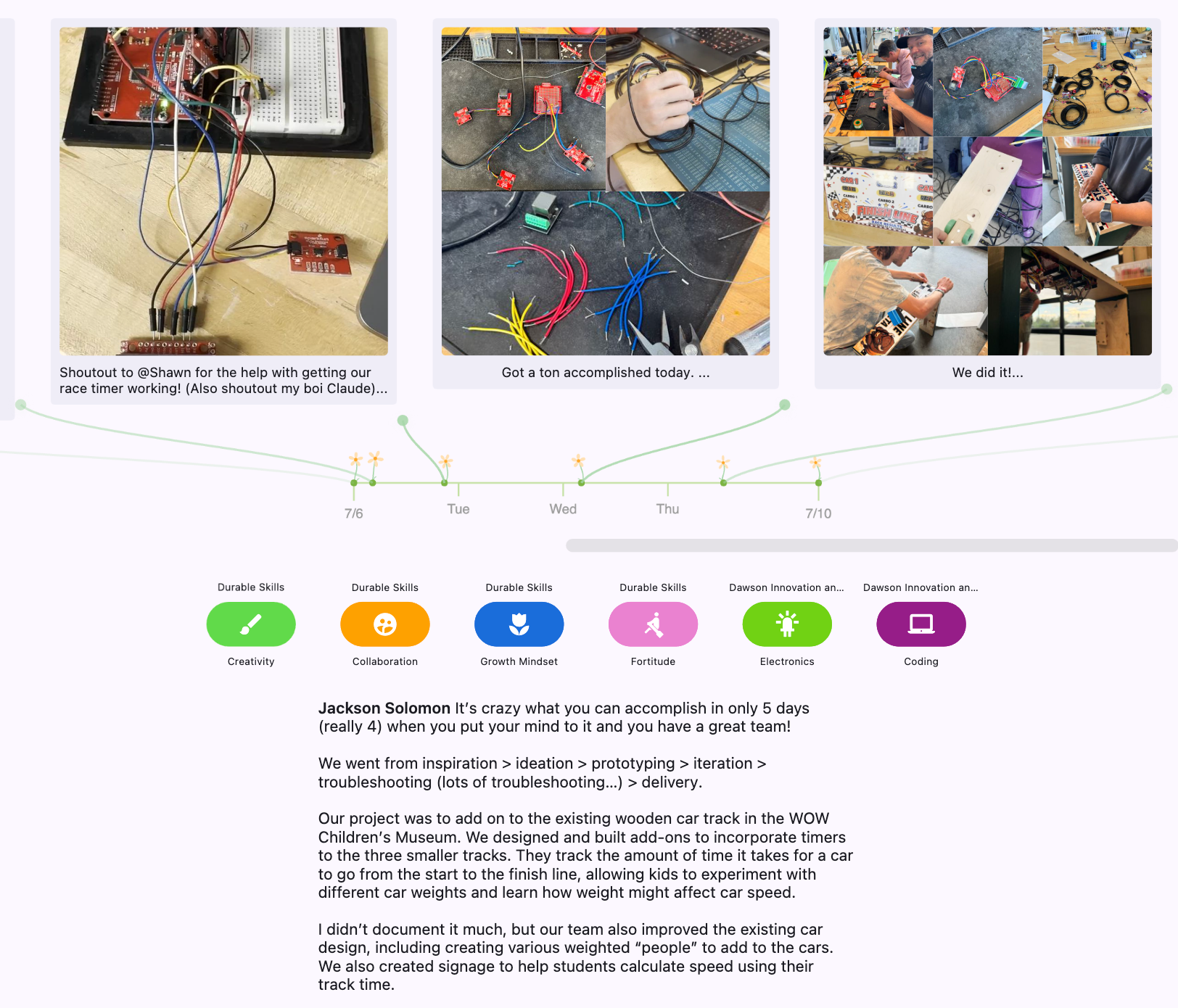
Our plan was to add a start and finish line to the track, with embedded electronics to time each run and read out the result on an LCD screen. A kid could release a car, see exactly how long it took, then swap the weights and compare against their original time (ex: the heavier car finished half a second faster).
We accomplished this using microcontrollers (an Arduino Uno, plus proximity sensors) and small LCD screens. Beyond the electronics, we added fun vinyls to the track to simulate roads and different types of Colorado terrain (city, plains, mountains), and updated the car designs with ball bearings in the wheels and heavier weights to really affect the speed.
The biggest challenges we ran into:
Despite all that, we eventually got the full setup working! Check out my Unrulr post to see the electronics in action. Fabricating the new cars and weights and printing the vinyls went much more smoothly, though I wasn't involved much in those parts; my teammates did an excellent job.
While we completed every component of our design, we ran out of time to fully install our additions. We plan on wrapping up install in the coming weeks.
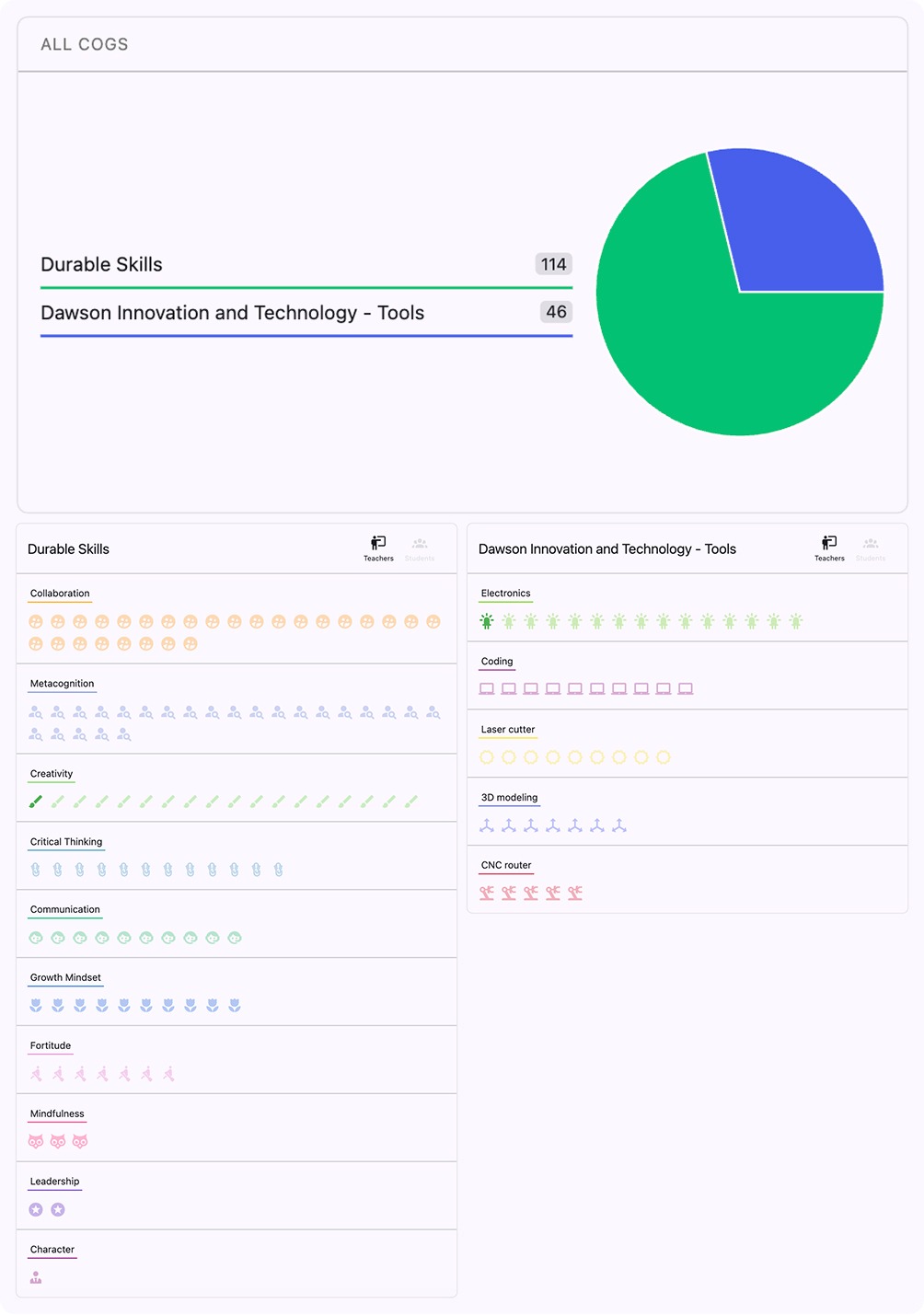
We used Unrulr to document the entire experience, from project progress, reflections, and collaborative sharing between teammates, to final products. Documentation happened through writing, photos, videos, audio recordings, and PDFs, capturing both Durable Skills (like collaboration, communication, grit, creativity) and Technical Skills (like laser cutting, CNC, 3D printing, vinyl printing, fabrication).
This wasn't Unrulr's first rodeo with this crew, either: Jeff and Chris use Unrulr with their makerspace and entrepreneurship students at Dawson, and Zack uses it with his Aesthetics of Design students at CU Boulder. But for most participants, this was their first hands-on experience with the tool.
Scaffolding came from two directions: in-person prompts ("Post what you hope to accomplish today!") and Prompts posted inside the app that worked like discussion questions participants could respond to with Unrulr posts.
The result: 72 posts across 21 people in 5 days.
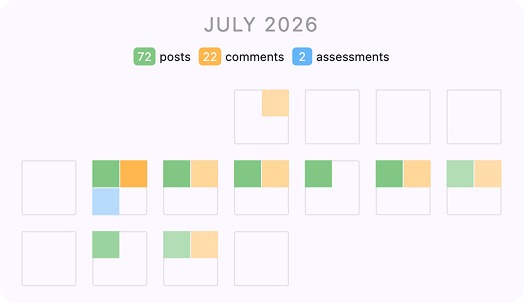
This was a different rhythm than how Unrulr is typically used. We usually see documentation unfold over a semester, a year, or longer. Onboarding a group and building a documentation habit in just 5 days was a challenge for sure, but it worked. It turned out to be a great case study for using Unrulr with adults and for short-term events like hackathons or conferences.
I'll be honest: I don't get many opportunities to work shoulder-to-shoulder with educators this intensively. Spending a week building, problem-solving, and nerding out with 20 badass educators was so much fun.
The thing I keep coming back to is the people. There's something about a week of shared deadlines, shared struggles, and shared sawdust that compresses years of relationship-building into five days. Friendships I brought into the week came out deeper. People who were strangers on Monday were friends by Friday. And, it reminded me of something I already knew but love being reminded of: educators are just awesome people. The warmth, passion, knowledge, generosity, and energy in that room all week was (in the parlance of Aaron Schorn) insane! It's the reason we do what we do.
It was also a full-circle moment. About a decade ago, I was a student at CU Boulder's ATLAS Institute, back when the Creative Technology Design degree was still called Technology, Arts, and Media, and before Zack had even joined. That's where I first learned the skills of electronics, sensors, soldering, and Arduinos. Those skills had thoroughly atrophied, and this week forced me to dust them off. Plugging an Arduino into my laptop for the first time in over ten years? So fun. Diving back into code (with generous help from Shawn, and from Claude)? Genuinely fun. Hours of soldering, re-soldering, and the accompanying fumes? Less fun. Worth it.
And it was another chance to truly dog-food our own product— not demoing Unrulr, but using it, as a learner, in the middle of a challenging, fast-moving project. I felt the same things many students feel: forgetting to document when I was deep in the work, scrambling to reflect at the end of a long day, and then the genuine satisfaction of looking back at a week of posts and seeing my learning laid out in front of me. That perspective is really valuable, and I'm bringing it to my work at Unrulr.
Five days goes fast. Learning a client's needs, brainstorming, prototyping, iterating, and delivering a finished product in one week is a sprint. Most teams finished their builds, but none got theirs installed during the Jam. Jeff and the Dawson crew are handling installs afterward.
Working off-site from your client is tricky. My team made at least one return trip to the museum for measurements and photos we should have captured the first time, and I know we weren't alone. Take more reference photos than you think you need!
Being the student is humbling, and valuable. We had to do everything educators ask of their students: work with a client, form teams, learn new technical and SEL skills, iterate under a deadline, and document and reflect along the way. If you lead a makerspace or work in experiential learning, putting yourself in that seat builds real empathy for your students and models exactly what we hope to impart to them.
Show the destination first. If I could redo one thing about how we introduced Unrulr, it would be to open with a real, finished example (a completed Journey, a polished Portfolio, a fully fleshed-out profile) and say: "This is what you (and eventually your students) can walk away with if you document and reflect with intention." We covered the purpose of documentation well, but backwards design can help, too. Our theory is that learners will document with more fidelity when they can picture the end product they are working towards.
For everyone taking this back to their own learning communities, here's what worked for us:
To Jeff, Chris, Glenn, Zack, and Shawn, thank you for your generosity with your time, knowledge, and an honestly jaw-dropping makerspace.
To Josie and the WOW Children's Museum, thank you for being the best client a group of makers could ask for.
And, to my fellow participants: the creativity, skill, and passion in that room was invigorating. I hope you take what we practiced back to your own learning communities.
If you're thinking about how documentation and reflection could work in your own makerspace, classroom, or event, that's exactly what Unrulr is for.
Book a demo or create an Unrulr account today.
Subscribe to our newsletter for more great content!
